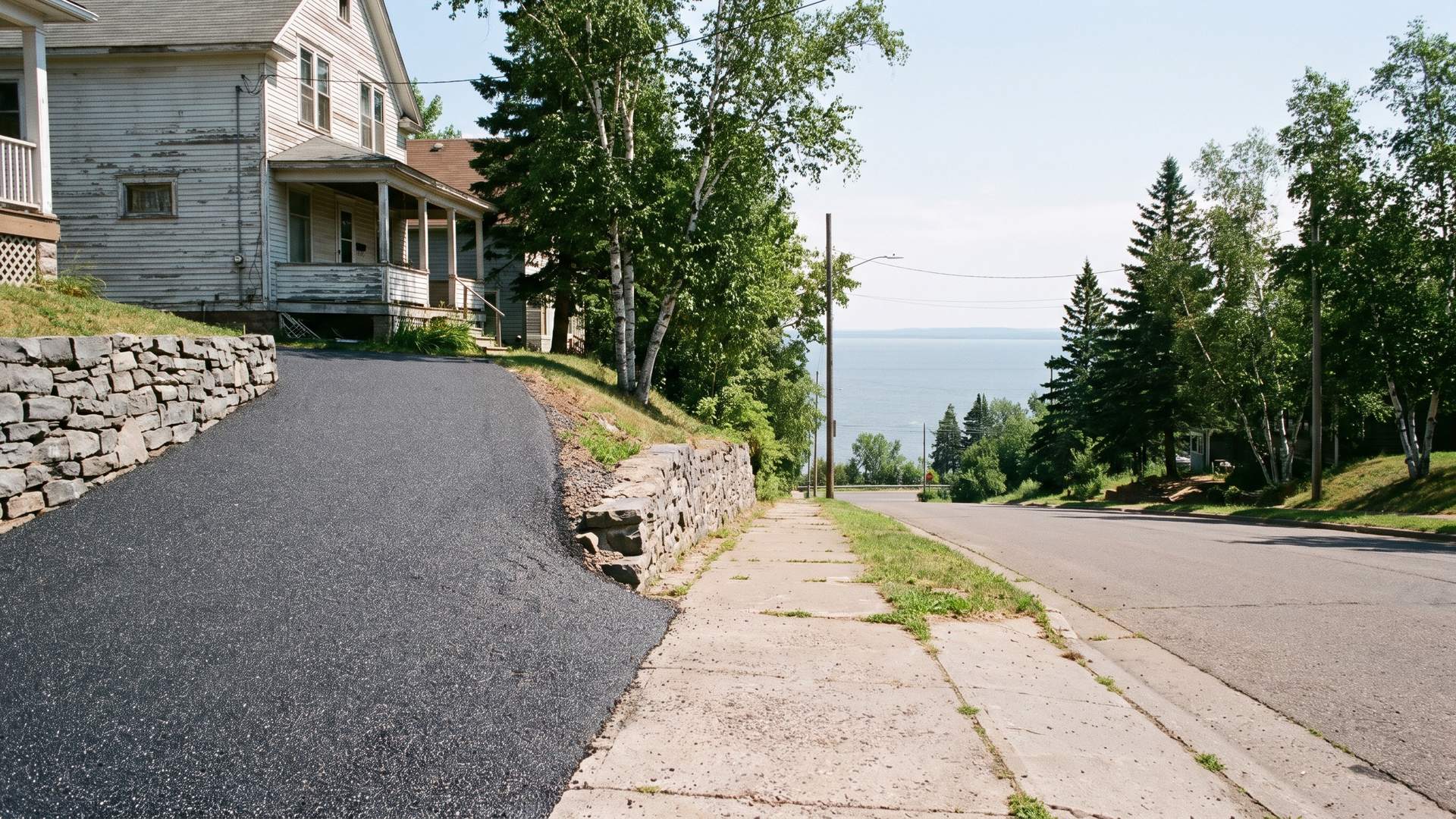
Asphalt Sealcoating in Cloquet, Minnesota
On the St. Louis River about 20 miles southwest of Duluth, the Carlton County city of Cloquet had 12,568 residents and 5,399 housing units in the 2020 census, and part of it lies within the Fond du Lac Reservation. Its pavement numbers are the harshest of the three NOAA stations used on this site. The Cloquet co-op station's 1991-2020 normals record 186.2 freezing nights a year and 98.3 freeze-thaw days, about 20 more than Duluth's hilltop airport.
The cause is a wide daily swing. Cloquet's summer afternoons are warmer than Duluth's, with 42.2 days a year reaching 80 degrees against 22.8 at the airport, yet its nights freeze more often. For asphalt that means more crossings of the freezing line in spring and fall and a frost-free median of only May 28 to September 22. Keeping cracks closed comes first, and crack filling in late summer is the place to start.
Free quote
Cloquet ground, housing and local rules
The soil series that carries the city's name was typed near Sawyer in Carlton County. The Cloquet series formed in a loamy mantle over gravelly outwash and is somewhat excessively drained, with rapid permeability in the gravel below. Driveways on well-drained ground like that face less frost heave than those on red clay, because water does not linger to freeze in the base, but loose sand and gravel at unsupported edges can ravel and let the asphalt break away. Edge support and compaction matter more here than extra drainage.
Cloquet rebuilt after the October 1918 fire, which started from railroad sparks and killed 453 people across the region. Today NeighborhoodScout's ACS-based figures put 27.3 percent of its homes before 1940, 32.0 percent from 1970 through 1999 and 14.9 percent at 2000 or newer, with single-family detached houses at 71.26 percent of units. Minnesota's coal-tar ban covers Cloquet like the rest of the state, and the city's Public Works department publishes overnight on-street parking restrictions and a snow and ice control policy.
See Cloquet, MN on Google Maps — we cover the whole area from Duluth.
Asphalt Sealcoating Services Available in Cloquet
The same seven services reach Cloquet:
See the full pricing guide for typical ranges.
Cloquet FAQs
Why does Cloquet log more freeze-thaw days than Duluth?
Because it cools off harder at night. Cloquet sits inland on the St. Louis River, away from Lake Superior's moderating influence, so clear nights drop below freezing more often even when afternoons are warm. Cloquet's normals list 186.2 freezing nights a year, against 176.7 at the airport and 158.7 in Superior. Each of those nights that follows a thawed afternoon is another freeze-thaw cycle for the pavement.
What is the sealing window in Cloquet?
Shorter than anywhere else this site covers. The Cloquet station's median last spring freeze is May 28 and its first fall freeze is September 22, a 116-day frost-free season. Sealer needs air and pavement at 50 degrees and rising and a dry 24 hours, so the practical window runs from mid-June through August. Patching should be finished early, since fresh patches need a month or two of cure before sealer goes over them.
Does sandy, well-drained ground mean a Cloquet driveway needs less base?
No. Good drainage reduces frost heave, but the base still carries the load. HomeGuide's residential figures, 2 to 3 inches of asphalt over 6 to 8 inches of compacted gravel, apply here too, rising to 3 to 4 inches over an 8- to 10-inch base where heavier vehicles park. What well-drained soil changes is how quickly the base firms up again after a spring thaw.
Get Your Free Cloquet Quote
Free quote